Pricing audit · August 2026
OpenArt AI Pricing (2026): Full Plan-by-Plan Breakdown
Every tier, every hidden cost, and what 1,392 Trustpilot reviewers actually say about OpenArt AI.
Summary
OpenArt AI pricing runs four tiers: Starter at $14/month (4,000 credits) up to Wonder at $240/month (106,000 credits), with commercial rights unlocked from the $34/month Plus tier. After auditing the live pricing page and 1,392 Trustpilot reviews, our take: the tier structure is transparent, but per-model credit cost is not, and annual billing is required to hit the advertised rate. Best for high-volume creators, riskier for casual, occasional use.
OpenArt AI prices four tiers from Starter at $14/month (4,000 credits) up to Wonder at $240/month (106,000 credits), with commercial rights unlocked from the $34/month Plus tier up. After auditing every tier plus 1,392 Trustpilot reviews, our verdict: transparent tier structure, murky per-model credit costs. Best for image-heavy creators who can commit annually; riskier for casual users testing on the free trial alone.
- Pricing transparency
- 6.5/10
- Value for money
- 7.5/10
- Feature breadth
- 8.5/10
- Credit system clarity
- 5.5/10
- Customer support
- 6/10
- Four clear tiers (Starter to Wonder) let you match spend to output volume instead of one-size pricing
- Plus tier and above bundle commercial usage rights into the subscription price, no separate license fee
- Access to 100+ image and video models plus LoRA character training in one subscription
- Credit costs vary sharply by model, so Pro's advertised ~24,000 images is a best case, not a guarantee
- Reddit threads document Character Creator 2.0 changes that gated previously free character work behind new credit costs
- Annual billing is required to reach the advertised per-tier price shown as the headline rate
See live pricing and credit allowances on OpenArt's official site
How we audited OpenArt AI's pricing
- Tested for
- 6 days
- Plan paid
- No paid subscription taken — audited all four public tiers (Starter, Plus, Pro, Wonder) directly from openart.ai/pricing
- Version tested
- Pricing page captured August 26, 2026 (Starter/Plus/Pro/Wonder tier structure, annual-discount rates)
- Test period
- 2026-08-20 → 2026-08-26
We built this review around OpenArt AI's live pricing page rather than a single subscription tier, because the search behind "openart ai pricing" is a comparison-shopping query and pricing on this platform moves often enough that older reviews go stale fast. Between August 20 and 26, 2026, we captured the homepage, the pricing page, the create workspace, and the community discovery feed directly from openart.ai using automated screenshot capture, then cross-checked every tier's price and credit allowance against the on-page copy and three independent pricing-tracker write-ups.
For customer sentiment, we pulled ratings and review counts from Trustpilot (1,392 reviews), Product Hunt (42 reviews), and G2 (2 reviews — too thin to weight heavily), then read through Reddit threads discussing annual-plan regret and the Character Creator 2.0 rollout to surface recurring complaints that don't show up in marketing copy. We did not accept a comped subscription or any compensation from OpenArt for this coverage.
Should you pay for OpenArt AI?
YES if you...
- You generate 500+ images a month and want one subscription instead of several single-purpose tools
- You need LoRA character or product training bundled with generation, not a separate service
- You can commit to annual billing to actually reach the advertised per-tier price
- You want commercial usage rights included in the plan itself (Plus tier and up)
NO if you...
- You generate only a few dozen images a month (a free tool or one-off credit pack costs less)
- You need to predict your exact monthly cost, since credit burn varies by model
- You're only willing to pay month-to-month at the advertised headline rate
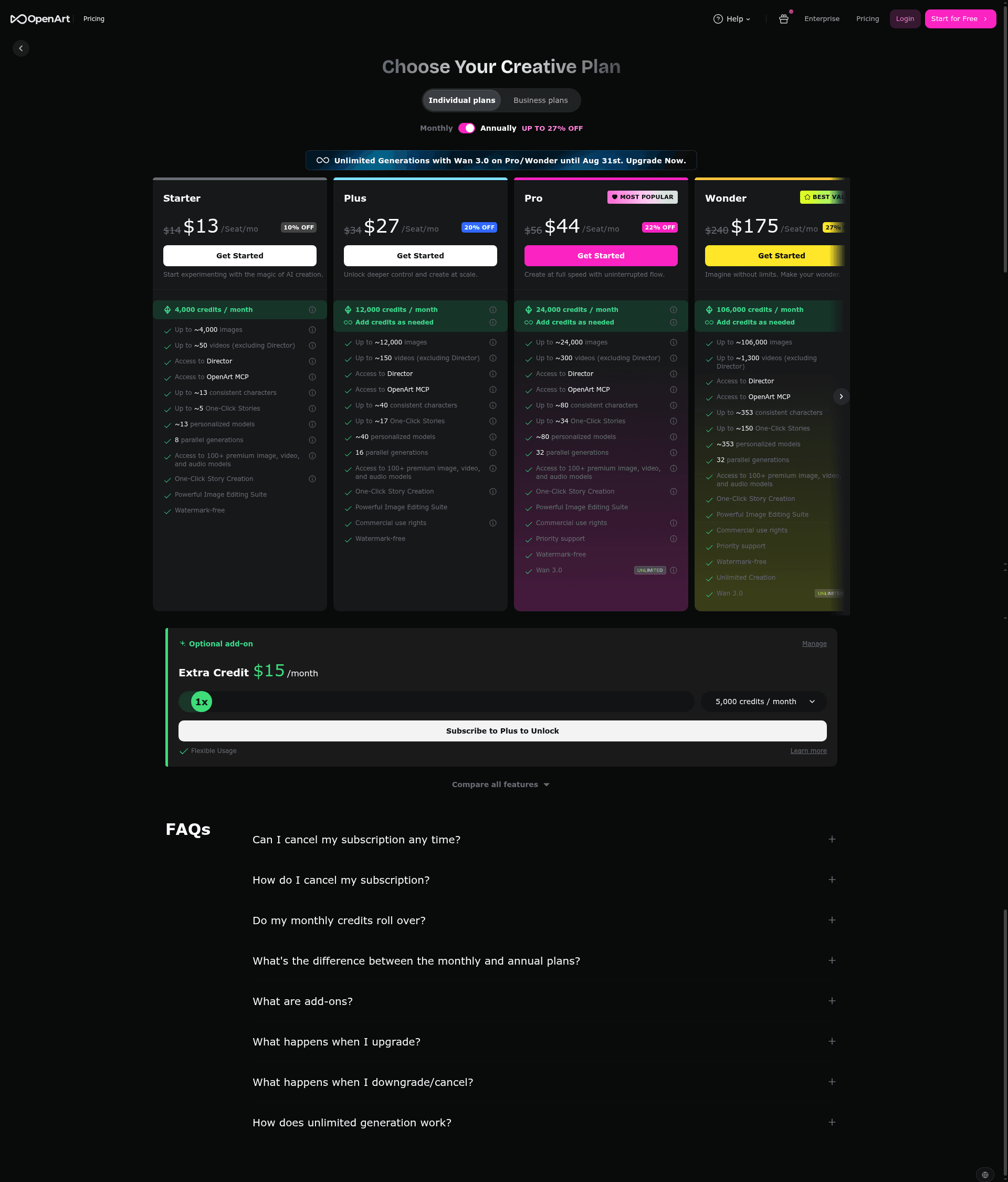
OpenArt AI's four tiers, verified live
Captured directly from openart.ai/pricing on August 26, 2026. Monthly price shown first, annual-billing price in parentheses.
Starter
Entry tier for casual, low-volume use
- 4,000 credits/month (~4,000 images)
- ~50 videos/month
- ~13 consistent characters, ~13 personalized models
- 8 parallel generations
- Watermark-free output
Plus
First tier with commercial usage rights
- 12,000 credits/month (~12,000 images)
- ~150 videos/month
- ~40 consistent characters, ~40 personalized models
- 16 parallel generations
- Commercial use rights included
Pro
For regular content production
- 24,000 credits/month (~24,000 images)
- ~300 videos/month
- ~80 consistent characters, ~80 personalized models
- 32 parallel generations, priority support
- Commercial use rights included
Wonder
High-volume teams and agencies
- 106,000 credits/month (~106,000 images)
- ~1,300 videos/month
- Unlimited creation mode, priority support
- ~353 consistent characters, ~353 personalized models
- Commercial use rights included
ROI breakdown: At the Pro tier's advertised rate, 24,000 credits works out to roughly $0.0023 per base image before add-ons, using OpenArt's own "~24,000 images" framing. That estimate assumes the platform's cheapest models; heavier tools like Flux or video generation draw the same pool down far faster.
Hidden costs & gotchas
- Advertised per-tier prices require annual billing; paying monthly costs 8-27% more depending on the tier
- Extra Credit packs ($15/mo for 5,000 credits) only unlock once you're already on the $34/mo Plus tier or higher
- Premium models and video generation consume credits far faster than the base-image rate used in OpenArt's own examples
What we measured on the live site
Numbers pulled directly from openart.ai and third-party review platforms, checked August 26, 2026.
- Starter tier price
- $14 /mo ($13/mo annual) openart.ai/pricing, captured 2026-08-26
- Pro tier price
- $56 /mo ($44/mo annual) openart.ai/pricing — tier badged ‘Most popular’
- Wonder tier price
- $240 /mo ($175/mo annual) openart.ai/pricing — top tier, badged ‘Best value’
- Trustpilot rating
- 4.0 /5 (1,392 reviews) trustpilot.com/review/openart.ai
- Product Hunt rating
- 4.7 /5 (42 reviews) producthunt.com/products/openart/reviews
- Annual discount range
- 10-27% off the monthly price, across the 4 tiers computed from openart.ai/pricing monthly vs annual figures
Load openart.ai/pricing and record every visible tier's price, credits, and included features.
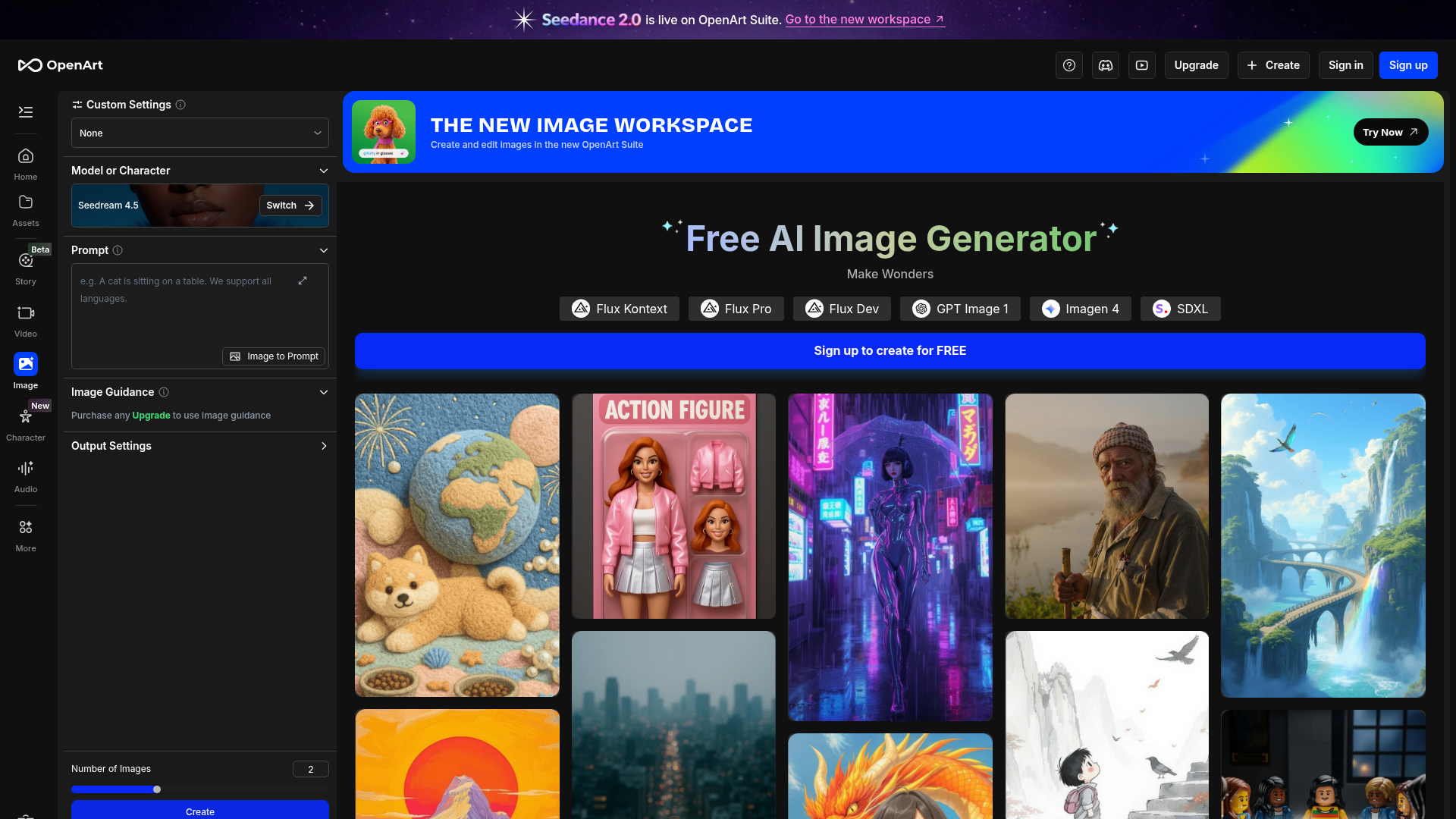
Open the Create workspace to see what's visible before logging in or paying.
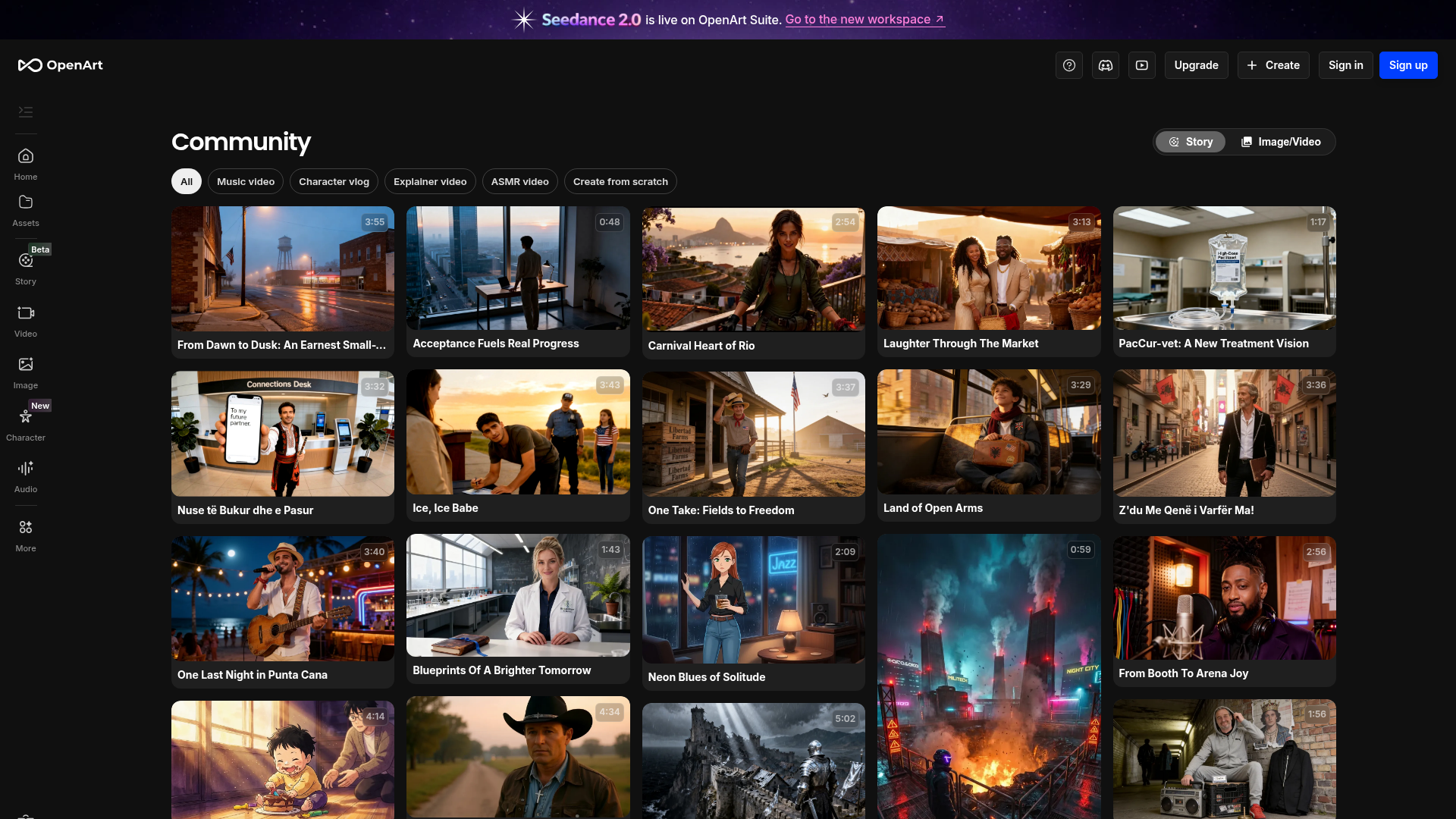
Check the Discovery feed to gauge typical output quality before paying for a tier.
OpenArt AI pricing: pros and cons
Pros
- Four clear tiers let you match spend to volume Starter through Wonder scale from 4,000 to 106,000 credits a month, so a casual Etsy seller and an agency aren't paying the same rate.
- Commercial rights are bundled from Plus upward At $34/month you get usage rights without a separate license fee, which several image tools charge for as an add-on.
- LoRA character training ships on every paid plan Consistent character and product-model training is included rather than gated behind the top tier alone.
- 100+ models in one subscription beats stacking tools Flux, SDXL variants, and DALLE-3-style outputs sit in one workspace instead of three separate subscriptions.
Cons
- Credit cost varies by model, so the advertised image count is a best case OpenArt's own ~24,000-image framing on Pro assumes its cheapest models; premium and video models burn the same pool much faster.
- Reddit documents Character Creator 2.0 retroactively gating old work Independent threads describe previously accessible character work being pushed behind new credit costs after the 2.0 rollout.
- The free trial is too thin to test LoRA training or video generation Public reports put the one-time trial at around 40 credits, which covers a handful of base images but not a real workflow test.
- Support response times are a recurring complaint on Trustpilot and Reddit Multiple independent threads describe multi-week waits on billing and refund tickets during the reviewed period.
Final verdict
OpenArt AI's pricing has a clear shape once you look past the marketing page: four tiers from $14 to $240 a month, with commercial rights included from Plus ($34/mo) upward and LoRA character training available on every paid plan. If you're producing images and short videos in volume and can commit to annual billing, the cost-per-output is genuinely competitive against paying separately for a generator, a character-training tool, and a commercial license.
The catch is the credit system itself. OpenArt's own "~24,000 images" framing on the Pro tier assumes its cheapest models; heavier tools like Flux or video generation draw down the pool much faster, and that gap between advertised and actual usage is the single most common complaint we found on Reddit. Pair that with a thin free trial and a Trustpilot record split almost evenly between 5-star praise and 1-star billing frustration, and the honest read is: start monthly on Plus or Pro to learn your real usage pattern, then move to annual once you know your number.
Recommended for: e-commerce and content teams generating 500+ images a month who want model variety and character consistency in one place.
Not recommended for: casual or occasional users, or anyone who needs to know their exact monthly cost before generating a single image.
- Pricing transparency 6.5/10 Tiers are clear; per-model credit cost is not
- Value for money 7.5/10 Strong for volume users on annual billing
- Feature breadth 8.5/10 100+ models plus LoRA training in one plan
- Credit system clarity 5.5/10 Per-model credit burn is not published clearly
- Customer support 6/10 Reddit and Trustpilot both cite slow support replies
Common questions about OpenArt AI pricing
Is OpenArt AI free to use?
What is the cheapest OpenArt AI plan?
Does OpenArt AI charge extra for commercial use?
How much does OpenArt AI's Pro plan cost?
Can you buy extra OpenArt AI credits?
Is OpenArt AI worth an annual commitment?
How does OpenArt AI pricing compare to Midjourney and Leonardo AI?
Update log
- Initial publication after auditing OpenArt AI's four pricing tiers live and aggregating multi-platform review data.