What to Write in a Christmas Card: Matching the Mood
Summary
Most guides on what to write in a christmas card hand you 150 interchangeable phrases. This article works differently: the words you choose should match the visual mood of the card. A dark, candlelit design calls for different language than a bright Scandi flat lay. Below you will find message categories organised by relationship type and visual register, so the card reads as one coherent object, not two separate decisions.
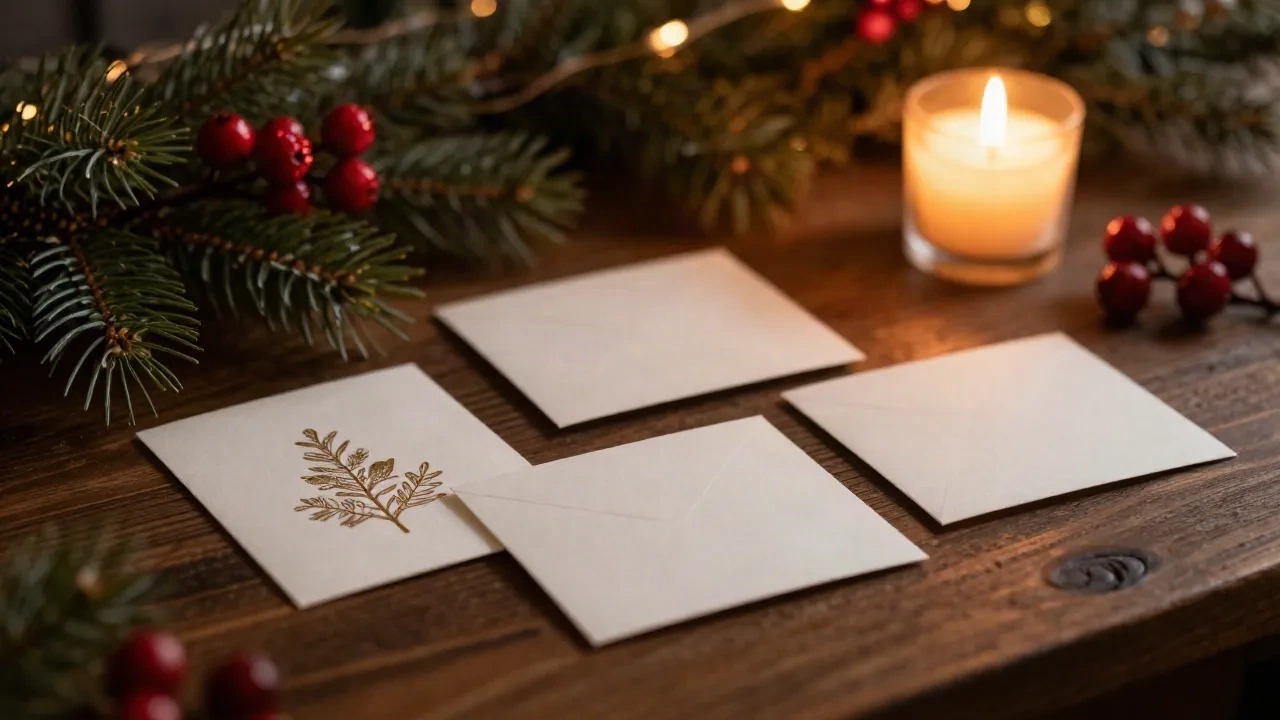
Knowing what to write in a christmas card stops most people mid-reach for the pen. The short answer: one or two sentences that reference something real about your relationship with the recipient, not a phrase lifted from a greeting card template. This guide organises message options by visual mood, relationship type, and card format, so you can match the copy to the image and send something that reads as intentional.
Americans send approximately 1.3 billion Christmas cards each year. Almost none of them say anything the recipient remembers a week later. That is not a failure of effort -- it is a failure of pairing. The words go into the card before anyone thinks about what the image is doing.
Why Christmas Card Messages All Sound the Same
There is a standard Christmas card message format that almost everyone follows without realising it. It goes: seasonal opener, wish the recipient something vague, sign the family name. "Wishing you joy and warmth this holiday season, The Johnsons." It is perfectly acceptable. It is also invisible.
The problem is not the content -- it is the disconnect between visual and verbal. A card with a dark, candlelit, moody photograph does not call for "Wishing you all the brightness of the season." A bright Scandi flat lay with linen and dried citrus does not need "May the warmth of the holidays fill your heart." The image sets a register. The words that break from it read as an afterthought.
This guide works backwards from that. Before picking a message, read what the card image is already saying.
Read the Visual First: Your Card Mood Determines the Words
Most card-writing guides skip the visual entirely. They present 150 interchangeable phrases in no particular order. That approach works if you are sending a uniform batch to 200 people. For anything more personal, it misses the point.
There are roughly three visual moods for Christmas cards:
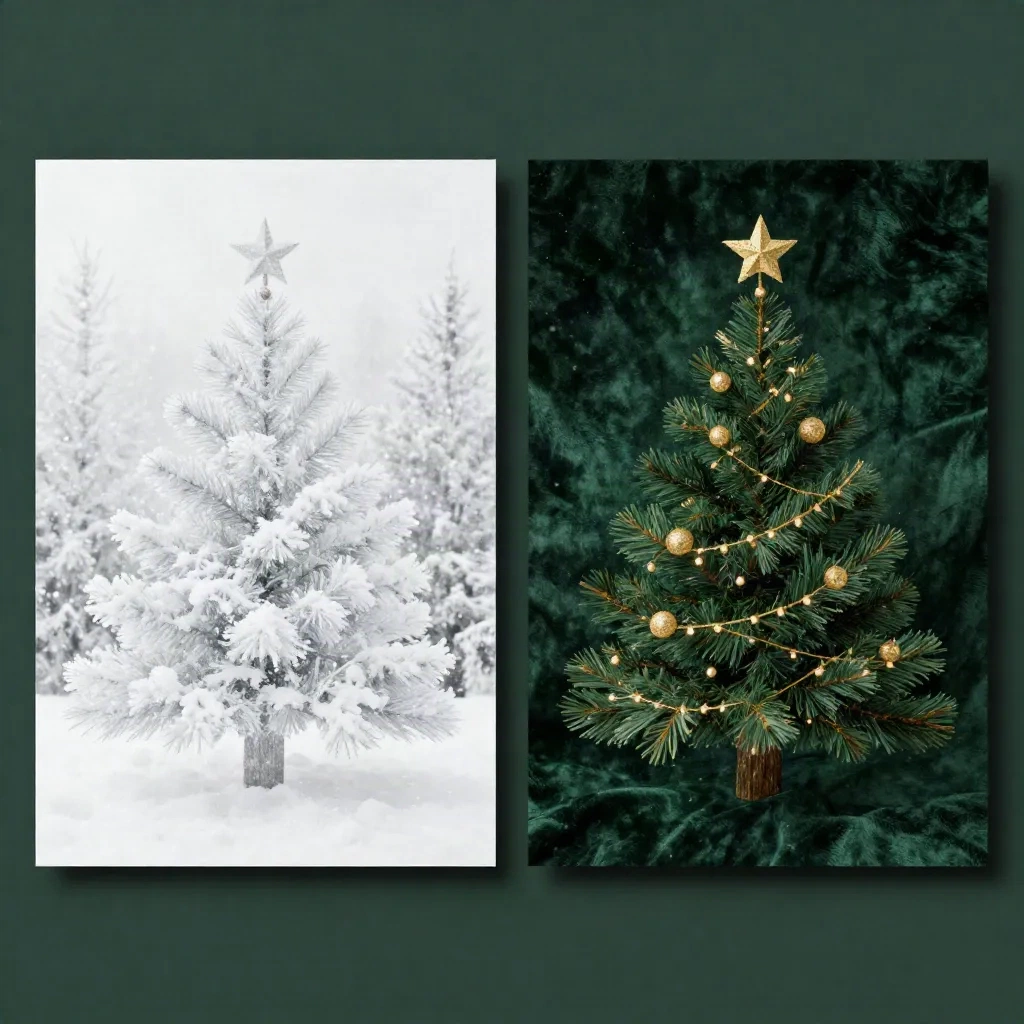
Warm and intimate -- close focus, candlelight, dark backgrounds, deep greens and reds. These cards want emotionally direct language. Short sentences. Something that acknowledges the year, not just the season.
Bright and clean -- white or cream backgrounds, minimal styling, natural light. These cards work with lighter, breezier language. Wit is allowed here. Warmth without heaviness.
Neutral and photographic -- a real family photo, a landscape, something documentary. These cards want specificity. Reference the photo itself, or something from the year that connects to the people in it.
The spell you cast on a photo -- a Season Swap that puts your product on a snowy windowsill, a Mood Shift that deepens a golden hour portrait into something quieter -- changes what the words need to do. Visual and verbal are one decision, not two.

What to Write in a Christmas Card for Family
For family, the pressure is high and the permissible range is wide. You can be funny, sentimental, specific, or brief -- the relationship covers all of it.
The skip to avoid: generic warmth with no referent. "Wishing you a wonderful Christmas and a happy new year" is what you write when you have nothing to say. Family notices.
For parents and in-laws: Reference something from the year. A visit, a meal, a thing they helped with. "This year was easier because of you" says more than "wishing you peace and joy" even though it is fewer words. If you do not have a specific memory, reference the relationship itself: "We are lucky to have you close."
For siblings: This is where wit works. One line that references a shared experience or an ongoing dynamic. "Still the better-looking one, but happy Christmas anyway." Or something quieter: "Another year, still glad it is you."
For extended family you rarely see: Keep it warm and short. "Thinking of you this December, hope this finds you well." Acknowledging the distance is better than pretending it does not exist.
For children in the family: Specificity wins. Name the thing they were excited about this year. Not "happy holidays" -- "hope the [thing they love] is still going strong." Children remember cards that say their name and something true about them.
In practice, a family card takes about 3 minutes when you have a specific memory in mind. Without one, it takes 15 minutes and lands worse.
For Friends: Messages With Warmth and No Sentimentality
With close friends, the register shifts. Full sincerity risks reading as earnest in a way close friendships do not require. But pure wit without any warmth reads as deflection. The useful range is one grounding sentence and one specific detail.
Works best: "Good year. Glad you were in it." Three words of substance, three words of truth. "Still your biggest fan, even after [the thing from this year]." "See you in January. Bring the [inside reference]."
Does not work: "Wishing you all the joy the season brings" -- this is what you write when you have forgotten to write anything personal.
For long-distance friends: The card itself is the gesture. Do not over-explain it. "This is me, saying I think about you, in the form of a card" works better than three paragraphs about the passage of time. The act of sending matters more than the specific words, but the words confirm the act was intentional.

Short Lines That Land When Nothing Comes to Mind
The hardest Christmas cards to write are the ones where the relationship is real but nothing specific surfaces. Maybe it was a quiet year. Maybe you are writing 40 cards and the ideas ran out at card 22. Here, short is honest.
Short messages that work across visual moods:
"Good December to you." "Happy Christmas, and an easier year ahead." "Glad this is still a thing we do." "Here is to next year." "Thinking of you this month." "Still here, still fond." "Warmth from this side of the year."
The functional rule for short messages: if it fits on a sticky note and still lands, it belongs on a Christmas card. If it needs explanation, cut to the core of what you are actually trying to say.
Where this approach breaks down: for people who expect real effort. Parents, close mentors, anyone who keeps cards. For those people, a one-liner reads as lazy even if it is well-crafted. Know your recipient before committing to brevity.
For Professional Contacts: Warm, Brief, in the Right Register
Business Christmas cards are underrated as relationship maintenance. A physical card reaches a desk in a way that a LinkedIn message does not. The standard here is different: warmth without familiarity, and brevity as a sign of respect for their time.
For clients: "It has been a good year working with you. Happy Christmas and looking forward to the next one." Specific to the relationship, no sentimentality.
For suppliers and vendors: "Thank you for the reliability this year. Happy Christmas."
For managers or senior colleagues: Let the card be the gesture. One sentence of genuine acknowledgement, then a seasonal close. Do not perform warmth you do not feel -- it reads immediately.
The limit of the professional card: it cannot substitute for actual relationship investment during the year. A card sent to a client you have neglected all year does not reset the dynamic.
For Etsy and Shopify Sellers: The Card as a Brand Touchpoint
If you run an Etsy shop or Shopify store, the card that goes into a customer order is a different object from a personal card. It is a brand touchpoint that happens to look like a seasonal greeting.
The mistake most sellers make: generic copy that could come from any brand. "Happy Holidays from [Shop Name]" is not a brand touchpoint, it is a label.
What works instead:
Reference the purchase. "Hope the [product] brings you exactly what you were looking for." This is specific, personal in the right way, and reminds the customer what they bought and why they wanted it.
Give a reason to return. One sentence -- a seasonal collection, a thank-you note, or simply that you have more of what they liked. Not aggressive, just present.
Match the card visual to your brand. If your shop identity is warm and handmade, the card image and copy need to match that register. A Season Swap that fits your product photography style reads as on-brand. A generic stock image does not.
The card visual and the card message are one object. Apply a Mood Shift spell to a product photo that matches your December listings, then write the four words that make that image say something. That combination is the thing that gets pinned to a corkboard or kept in a drawer.
The Friction: When Visual-Message Pairing Does Not Scale
The mood-matching approach is right when you are sending 5 to 30 cards. It does not scale to 200.
If you are a brand sending a large holiday mailing, you will need one message that works across your customer base, not 200 personalised ones. In that case: invest in the visual. A strong image with a short, genuine message outperforms a generic image with a long, crafted one. The visual is what gets looked at first. Get that right, then worry about the words.
The other limit: if you genuinely have nothing specific to say to someone, do not force specificity. A clean, short, honest seasonal greeting is better than a fabricated personal detail. "Happy Christmas, glad we know each other" is an honest card. Inventing a detail you barely remember is not -- recipients notice.
One more friction worth naming: the card that arrives in January. If you are the person who sends cards late, own it. "Belated, but genuinely meant" works. A January card sent without acknowledgement of its own lateness reads as an oversight, not a gesture.